



Search "mushroom coffee benefits" and you will be told it sharpens your brain, rebuilds your gut, calms your nerves, and fixes your immune system. Usually by someone selling it.
We sell it too. So here is a different kind of article. We went through the actual human research, trial by trial, and we are going to tell you what it supports, what it does not support, and one uncomfortable fact about dosage that almost no brand in this industry will put in writing.
By the end you will know exactly what you can reasonably expect from a cup, and what you should ignore.
First, the Uncomfortable Part: Dose
This is the most important thing on this page, so we are putting it first.
Most human studies on functional mushrooms use much larger doses than you get in any cup of mushroom coffee.
Take lion's mane, the most researched mushroom in the category. The well known Japanese trial on adults with mild cognitive difficulty used 3 grams per day of powdered lion's mane. A later trial used 3.2 grams per day. A pilot study in young adults used 1.8 grams.
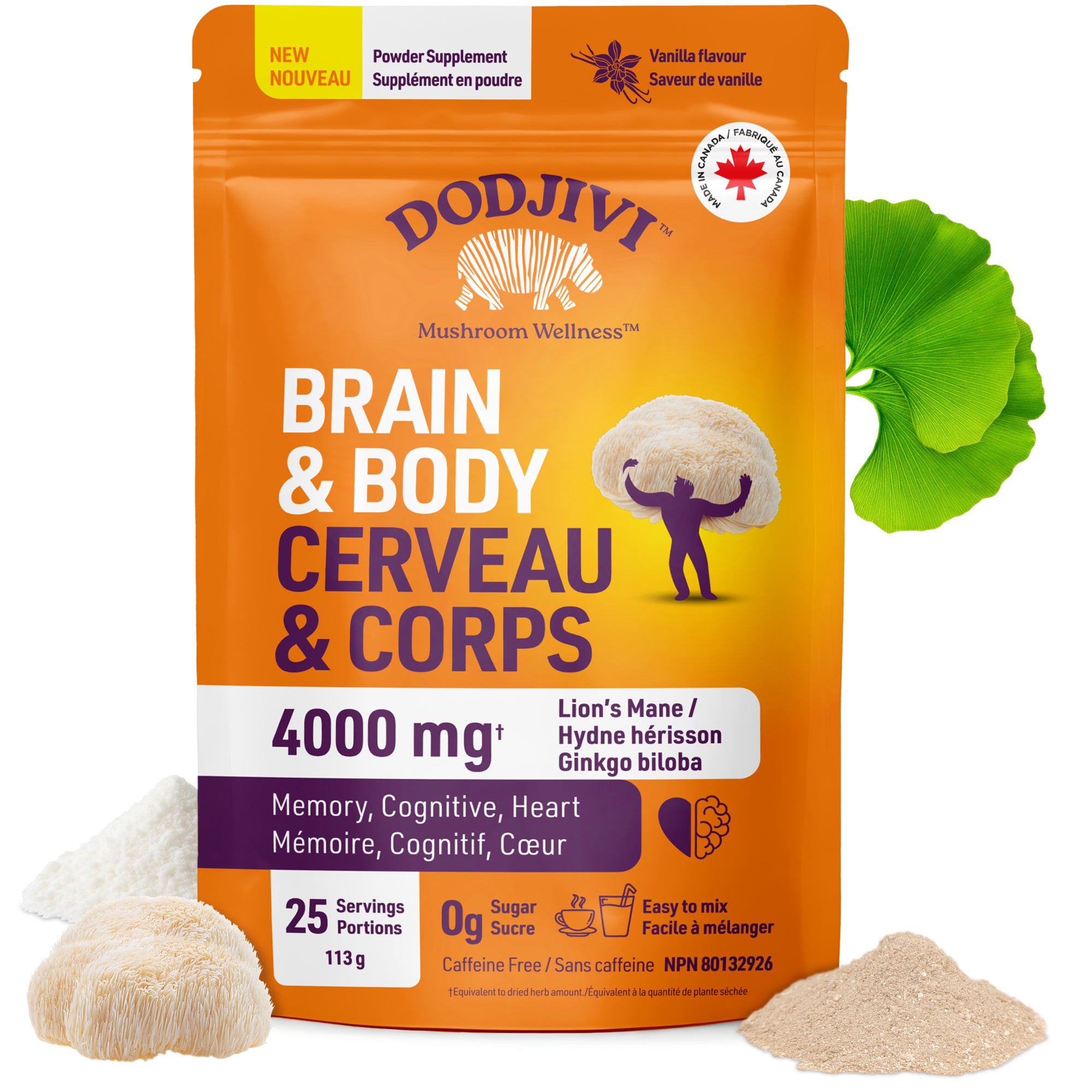
Now look at a typical mushroom coffee. Dodjivi 4 Protection contains 250 mg of lion's mane per serving. Other brands put 2,000 mg of total mushroom blend in a cup, spread across six different mushrooms.
So the honest maths: a cup of mushroom coffee gives you a fraction of the dose used in most published trials.
What this means:
- Do not expect a cup of coffee to reproduce a clinical trial result.
- Anyone promising you dramatic cognitive or immune effects from one cup is overselling.
- If you want study level doses of a single mushroom, a concentrated supplement is a more honest tool than a coffee.
So why drink mushroom coffee at all? Because it is a habit you already have. You are going to drink something warm tomorrow morning. The realistic case for mushroom coffee is not that one cup transforms you. It is that it swaps a high caffeine drink for a lower caffeine one with functional ingredients added, every single day, for years. Consistency is the mechanism. Not magic.
Now, with that framing in place, here is what the research does show.
Benefit 1: Less Caffeine, and This One Is Certain
This is the benefit that is real, immediate, and does not depend on any mushroom research at all.
Mushroom coffee replaces part of the coffee with mushroom powder, so there is simply less caffeine in the cup. Dodjivi 4 Protection contains about 59 mg of caffeine, against roughly 95 mg or more in a standard cup of brewed coffee.
Health Canada advises healthy adults to stay under 400 mg of caffeine per day. You can read the full Health Canada caffeine guidance for the details, including the lower limits for pregnancy and for children.
If you are someone who gets jittery, anxious, or wired from regular coffee, or who cannot sleep after an afternoon cup, this is the benefit you will actually feel. It is not a subtle, long term, maybe effect. It is arithmetic.
Benefit 2: You Are Still Drinking Coffee, and Coffee Holds Up Well
People forget this part. The base of mushroom coffee is coffee, and coffee itself has one of the better evidence records in nutrition.
A large umbrella review of coffee research published in the BMJ pooled more than 200 meta analyses. It found that moderate coffee drinking is generally safe and was more often linked with benefit than harm, with the largest risk reductions around three to four cups a day.
Two important caveats the authors themselves make. This is observational research, so it cannot prove cause and effect. And they specifically flag pregnancy as an exception, where the risks go the other way.
Still, the point stands. Choosing coffee is not the problem. You are just choosing a version with less caffeine and some extra ingredients.
Benefit 3: Lion's Mane and Focus (Promising, Not Proven)
Lion's mane is the reason most people try mushroom coffee. It is the "brain" mushroom.
The human evidence is genuinely interesting and genuinely limited.
- A 2023 pilot study on young adults found that a single 1.8 gram dose improved speed on a Stroop task, a standard test of mental processing. It also found a trend toward reduced stress after 28 days, but the researchers themselves cautioned that the sample was small and some results were null.
- A 2025 study on healthy young adults found that a single 3 gram dose produced no significant overall improvement in cognition or mood versus placebo, though performance improved on one specific dexterity task.
- Trials in older adults with existing cognitive difficulty have shown more encouraging results, but those used 3 grams or more per day for months.
Honest summary: the strongest signals come from higher doses, longer periods, and often from people who already had a cognitive complaint. Lion's mane is not a nootropic that hits you in twenty minutes. Treat any claim that it is as marketing.
Benefit 4: Reishi and Fatigue or Immune Markers (Moderate)
Reishi has more human research behind it than most functional mushrooms.
- A randomized controlled trial gave healthy adults a reishi derived beta glucan daily for 84 days. Those taking it showed measurable changes in immune cell populations, including natural killer cell counts and T lymphocyte levels, compared to placebo.
- A pooled analysis of 17 randomized trials covering nearly a thousand people found some significant effects, including small reductions in BMI and heart rate. It also found no significant effect on body fat, blood pressure, fasting glucose, lipids, or inflammatory markers.
That second finding matters. Reishi is not a metabolic shortcut, and the research says so clearly. Where it looks most promising is fatigue, wellbeing, and immune signalling, not weight or blood sugar.
Benefit 5: Turkey Tail and Gut Health (Real, and Underrated)
This is the mushroom nobody talks about, and it may have the most practical evidence.
In a randomized clinical trial, 24 healthy volunteers were given either polysaccharopeptide from turkey tail, the antibiotic amoxicillin, or nothing, and their stool was analysed over eight weeks. The turkey tail group showed clear and consistent gut microbiome changes consistent with prebiotic activity. The antibiotic group showed disruption that took weeks to recover from.
In plain language: turkey tail appears to feed the good bacteria in your gut, the way fibre does. That is a modest claim, but it is a well supported one, and it is why turkey tail belongs in a daily blend rather than a one off supplement.
Benefit 6: Chaga (Weakest Human Evidence, and We Will Say So)
We put chaga in 4 Protection. We are still going to be straight with you.
Chaga has a huge amount of laboratory and animal research behind it, mostly focused on antioxidant activity. What it does not have is a strong body of human clinical trials. Most of the confident claims you will read about chaga online are extrapolated from cells in a dish, not from people.
Chaga is also high in oxalates, which matters if you have kidney concerns. We covered that fully in our article on mushroom coffee safety, and we would rather you read it than skip it.
Chaga earns its place in a blend on tradition, antioxidant content, and flavour depth. It has not yet earned the medical claims some brands make for it.
What the Research Does Not Support
If a brand tells you mushroom coffee will do any of the following, be sceptical.
- Weight loss. The reishi meta analysis found a small BMI effect but no change in body fat or waist circumference. There is no good human evidence that mushroom coffee is a weight loss tool.
- Curing, treating, or preventing any disease. This is not permitted language in Canada for a reason. Functional mushrooms are food, not medicine.
- Instant energy. With less caffeine than coffee, mushroom coffee should feel calmer, not stronger. Anyone promising more energy than coffee is describing something else.
- Fixing your immune system. Some mushrooms appear to modulate immune markers. That is not the same as making you immune to getting sick.
- A same day transformation. Every trial that found something meaningful ran for weeks or months.
How to Actually Get the Benefit
If you want mushroom coffee to do something for you, the research points in one direction: consistency and honesty about dose.
- Drink it daily, not occasionally. Every trial with a positive finding used daily intake over weeks. A cup on Sunday does nothing.
- Use it to replace a high caffeine drink, not to add to one. The caffeine reduction is your most reliable benefit, and it disappears if you also drink three regular coffees.
- Check the label for individual doses, not just a blend total. A 2,000 mg "blend" of six mushrooms tells you nothing about how much of each you are getting.
- Prefer fruiting body over mycelium on grain where you can. Grain based mycelium products can contain a large share of starch rather than mushroom.
- Give it four to eight weeks before you decide anything, and pay attention to sleep and afternoon energy rather than expecting a jolt.
- If you want a clinical dose of one mushroom, buy that mushroom. Coffee is a habit, not a pharmacy. Both can be true at once.
Actionable Takeaways
- The most reliable benefit of mushroom coffee is lower caffeine, and it is the one you will feel first.
- Coffee itself is associated with good health outcomes in large reviews, so the base is not a compromise.
- Lion's mane research is promising but mostly uses 1.8 to 3 grams a day, far more than any coffee contains.
- Reishi has moderate evidence for fatigue and immune markers, and clearly negative evidence for weight and blood sugar.
- Turkey tail has solid human evidence as a prebiotic for the gut.
- Chaga has the weakest human evidence of the four, whatever the internet says.
- Consistency over months is what the research rewards. Nothing about this is instant.
Frequently Asked Questions
Does mushroom coffee actually work? It depends on what you expect. It reliably lowers your caffeine intake. Its functional mushroom doses are lower than those used in most clinical trials, so it should be treated as a daily habit rather than a clinical intervention.
What is the most researched mushroom in mushroom coffee? Lion's mane and reishi have the most human research. Turkey tail has strong evidence specifically as a gut prebiotic. Chaga has the least human trial evidence.
How long does mushroom coffee take to work? The caffeine difference is immediate. Any mushroom related effects, in the studies that found them, took weeks to months of daily use.
Is mushroom coffee good for gut health? Turkey tail has shown prebiotic activity in a randomized human trial, meaning it appears to support beneficial gut bacteria. Lower caffeine and lower acidity may also be gentler on some people's stomachs.
Does mushroom coffee help you lose weight? There is no good human evidence for this. Be very cautious of any brand that claims it.
Is mushroom coffee better than regular coffee? It is different, not automatically better. It has less caffeine and added functional ingredients. Regular coffee has more caffeine and a longer research record of its own. The right choice depends on how caffeine affects you.
The Bottom Line
Mushroom coffee is not a miracle and it is not a scam. It sits in the honest middle, which is an uncomfortable place for marketing but a good place for a product you drink every day.
What you can reasonably expect: less caffeine, fewer jitters, a gentler cup, a gut friendly prebiotic, and a small daily dose of ingredients with promising but incomplete human research behind them.
What you should not expect: a new brain, a fixed immune system, or weight loss.
If that sounds underwhelming, it is only because you have been reading other people's marketing. A better daily habit, held for years, is worth more than a miracle you would have stopped believing in by March.
This article is for information only and is not medical advice. Dodjivi products are not intended to diagnose, treat, cure, or prevent any disease. Please consult a qualified healthcare professional before making health related decisions.


